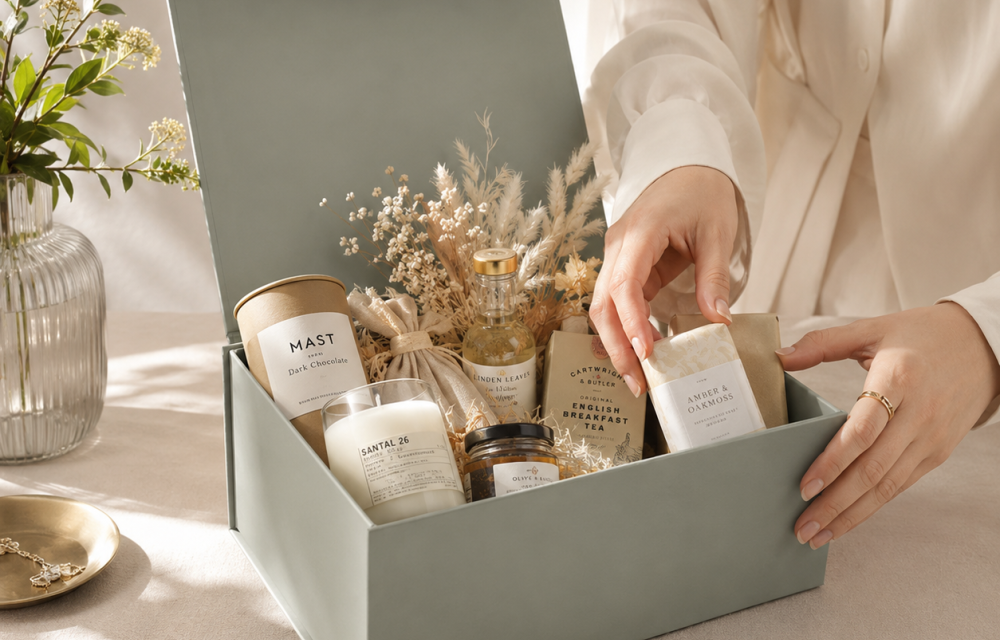
Selecting The Perfect Hamper Box Size For Bottles, Jars, And Gift Sets
The right hamper box makes every product look as though it belongs there.
Too small, and bottles, jars, or gift items may press against one another, distort the box, or leave no room for protective packaging. Too large, and the contents can slide around while the presentation feels sparse rather than generous.
For a small e-commerce business, box size affects more than the unboxing moment. It influences stock levels, storage space, packing speed, shipping costs, product protection, and how many packaging variations the team needs to manage.
This guide explains how to choose the right hamper box size by mapping the footprint of your products to the box’s usable internal space. It includes practical approaches for bottles, jars, mixed gift sets, and growing product ranges.
Need Hamper Boxes to get you started?
How Do You Choose The Right Hamper Box Size?
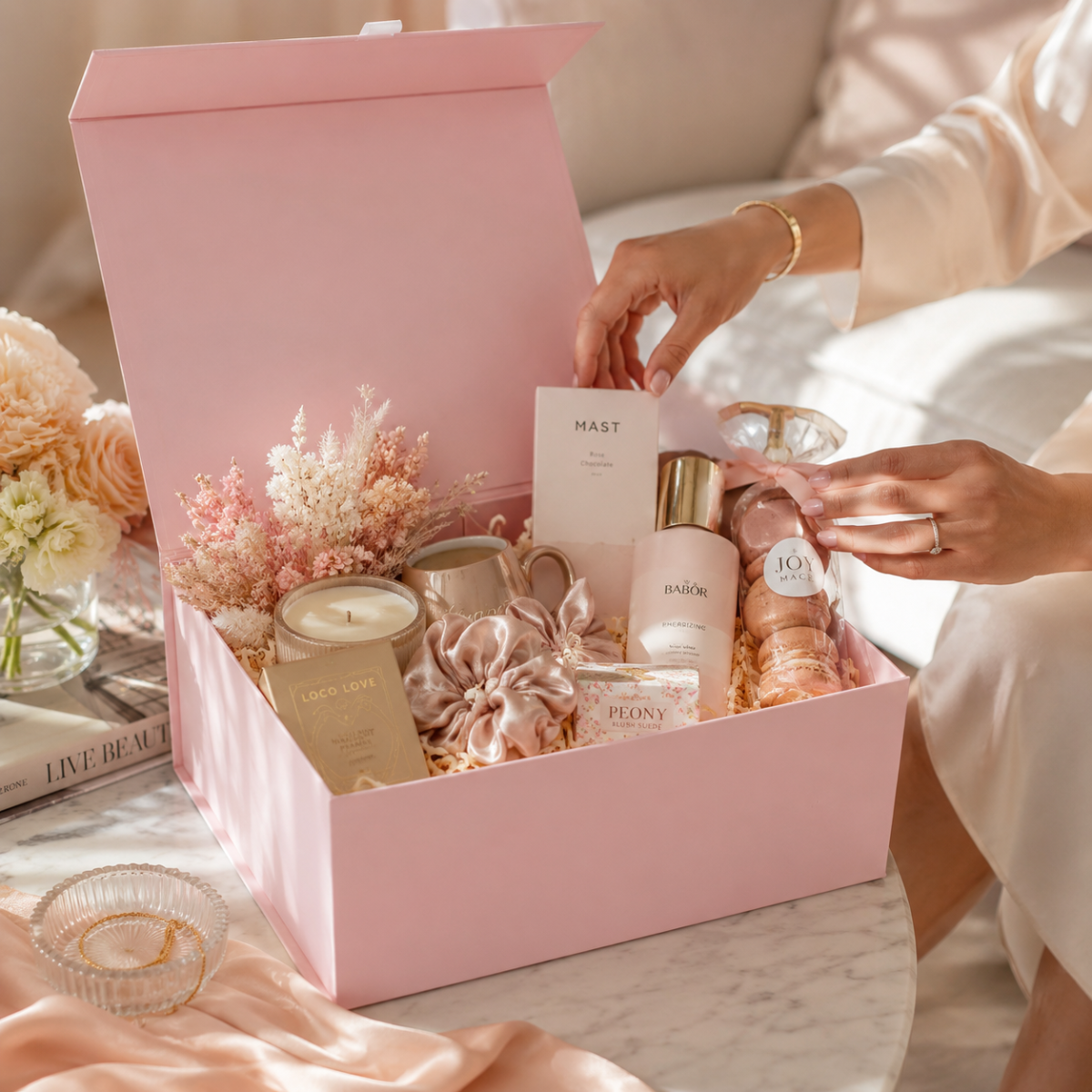
Choose a hamper box by measuring the complete product arrangement, including inserts and protective materials, then comparing that footprint with the box’s internal length, width, and height. The contents should fit securely without being crushed, overcrowded, or able to move freely.
A reliable process follows five steps:
- Measure every product at its widest and tallest points.
- Decide how the products will be arranged.
- Include the insert, dividers, and protective materials.
- Compare the completed footprint with the box’s internal dimensions.
- Test the packed box before ordering a larger quantity.
The best hamper box sizes for e-commerce are not simply the closest dimensions available. They are the sizes that support the product, presentation, packing process, and delivery method together.
Use Internal Dimensions, Not External Dimensions
Product fit should always be assessed against the usable internal space.
External dimensions include the board, walls, lid, folds, and construction of the box. They do not tell you exactly how much room is available for the contents.
When comparing hamper boxes, look for:
- Internal length.
- Internal width.
- Internal depth or height.
- Any reduction caused by the lid.
- The thickness of internal walls.
- The dimensions of the insert.
- Space occupied by dividers or corner supports.
If internal measurements are not clearly listed, ask the supplier before ordering.
A few millimetres can matter when several rigid products need to sit side by side, especially once dividers and cushioning are added.
Measure The Products At Their Widest Points
Packaging should be based on the largest real dimensions of each product, not only the dimensions printed on a label or specification sheet.
Measure:
- The widest point.
- The deepest point.
- The total height.
- The lid, cap, pump, handle, or decorative feature.
- Any product packaging that will remain in place.
- Irregular shapes or protruding components.
For bottles, the shoulder or cap may be wider than the main body.
For jars, the lid may extend beyond the container.
For pouches and wrapped products, the filled shape may differ from the flat packaging dimensions.
Measure physical products wherever possible. Supplier measurements are useful, but a sample allows you to identify the small details that decide whether the arrangement looks considered or crowded.
Map The Complete Product Footprint
The product footprint is the total area occupied by the arranged contents when viewed from above.
Do not calculate every product separately and assume the totals will fit. Arrange the items in the way they will appear inside the hamper, then measure the complete group.
A useful sizing method is:
- Required internal length = arranged product length + insert structure + protective allowance.
- Required internal width = arranged product width + insert structure + protective allowance.
- Required internal height = tallest packed item + base support + lid clearance.
The appropriate allowance depends on the products, box construction, insert, and delivery method. There is no universal gap that suits every hamper.
Create a physical layout using the real products, or make simple card templates to represent their footprints. This lets you test arrangements before committing to the box.
Decide On The Arrangement Before Choosing The Box
The same products can require very different box sizes depending on how they are arranged.
Possible layouts include:
- A single row.
- A two-by-two grid.
- A central hero product with smaller items around it.
- Bottles positioned upright.
- Bottles placed horizontally in fitted supports.
- Products grouped by height.
- A layered arrangement with a raised insert.
- Separate compartments for fragile items.
The arrangement should support the story of the gift.
A hero product may deserve more space and visual focus. Smaller products can be grouped around it, but they should not appear squeezed into leftover gaps.
The neatest arrangement is not always the most space-efficient one. Balance presentation with the cost and practicalities of the final box.
Choosing A Hamper Box For Bottles
Bottles need enough room for their complete diameter, cap, shoulder, and any protective support.
First decide whether the bottles will be packed upright or horizontally.
Upright Bottles
An upright presentation can make labels visible and create a strong reveal when the lid is opened.
Check:
- Total bottle height.
- Lid clearance.
- Stability at the base.
- Space for dividers.
- Movement around the neck.
- Whether the bottle can lean.
- The effect of the bottle’s weight on the base.
A bottle should not rely on shredded paper alone to remain upright during handling.
Horizontal Bottles
Horizontal placement can suit shallow hampers or create a more secure position for longer bottles.
Check:
- Complete bottle length.
- The widest diameter.
- Support around the neck and base.
- Whether the bottle can roll.
- Label visibility.
- Clearance from nearby products.
- The strength of the insert or divider.
For courier delivery, bottle protection needs more detailed testing than visual presentation alone. This guide focuses on selecting the general hamper size rather than designing a specialist bottle-shipping system.
Choosing A Hamper Box For Jars
Jars are often compact but heavy for their size.
When fitting jars into hamper boxes, consider:
- Lid diameter.
- Base diameter.
- Jar height.
- Glass or breakable construction.
- Product weight.
- Space between jars.
- Divider thickness.
- Whether labels need to face upwards or forwards.
- The stability of the base.
Several jars placed closely together may fit the footprint but create a heavy concentrated load.
The hamper box, base, and insert should all be suitable for the combined packed weight. For more guidance, read Choose board grades that carry the weight.
Choosing A Hamper Box For Mixed Gift Sets
Mixed gift sets can include products with very different shapes, weights, and heights.
Start with the largest or most visually important item, then arrange the smaller products around it.
Consider:
- Which product should be seen first.
- Whether labels face the recipient.
- How different heights affect the presentation.
- Whether heavier items sit over a supported area.
- Whether fragile items need separation.
- How gaps will be filled.
- Whether the arrangement remains stable when the box is lifted.
- Whether the same layout can be packed consistently.
A mixed set should feel curated, not as though every product was persuaded into the nearest available space.
Photograph the approved arrangement and use it as a packing reference. This can improve consistency across staff, shifts, and seasonal workers.
Measure The Packed Height Carefully
The tallest product does not always determine the complete required height.
You may also need room for:
- A base pad.
- A raised insert.
- Tissue paper.
- Protective material.
- Product lids or pumps.
- A presentation card.
- A folded message.
- Decorative filler.
- Lid construction.
Close the sample box naturally.
The lid should not press against the contents, push products sideways, or sit visibly raised. There should also not be so much unused vertical space that the products can leave their intended positions.
For delicate products, include the protection required above and below the contents in the height calculation.
Include Inserts And Dividers From The Start
An insert does not fit into leftover space. It creates the structure that holds and presents the products.
Its construction may reduce the usable internal dimensions through:
- Side walls.
- Dividers.
- Folded supports.
- Cut-outs.
- Finger access.
- Raised platforms.
- Protective pads.
- Product cavities.
Designing the arrangement first and adding the insert afterwards can result in a box that appears large enough but is too tight once the final structure is installed.
Whenever possible, test:
- The empty box.
- The insert.
- The products inside the insert.
- The fully closed hamper.
- The packed hamper after normal handling.
The final sample should represent the packaging you intend to send, not an optimistic arrangement with the protective components removed.
Allow Room For Protective Packaging
The right amount of protective material depends on the product and delivery method.
Possible materials include:
- Tissue paper.
- Paper padding.
- Corrugated inserts.
- Board dividers.
- Moulded fibre components.
- Shredded paper.
- Protective sleeves.
- Corner supports.
- Product-specific fittings.
Do not select an oversized hamper simply to hold large amounts of decorative filler.
Excess space can allow movement, increase material use, and make the gift look less considered. A better-sized box with a purposeful insert often creates a cleaner presentation.
Where protection is critical, complete appropriate handling and shipping tests before approving the packaging.
Consider Product Weight As Well As Size
A product arrangement can fit within the dimensions and still be unsuitable for the box.
Check the combined weight of:
- Every product.
- The insert.
- Protective materials.
- The box.
- Printed materials or accessories.
Weight affects:
- Base strength.
- Side-wall stability.
- Lid performance.
- Carrying comfort.
- Stacking.
- Packing-station handling.
- Outer shipping packaging.
- Courier requirements.
The correct board grade and construction should be confirmed with the packaging supplier using the complete packed weight.
The brief does not provide universal load limits, so these should not be assumed from the appearance of the box alone.
Tray-Style Or Lidded Hamper?
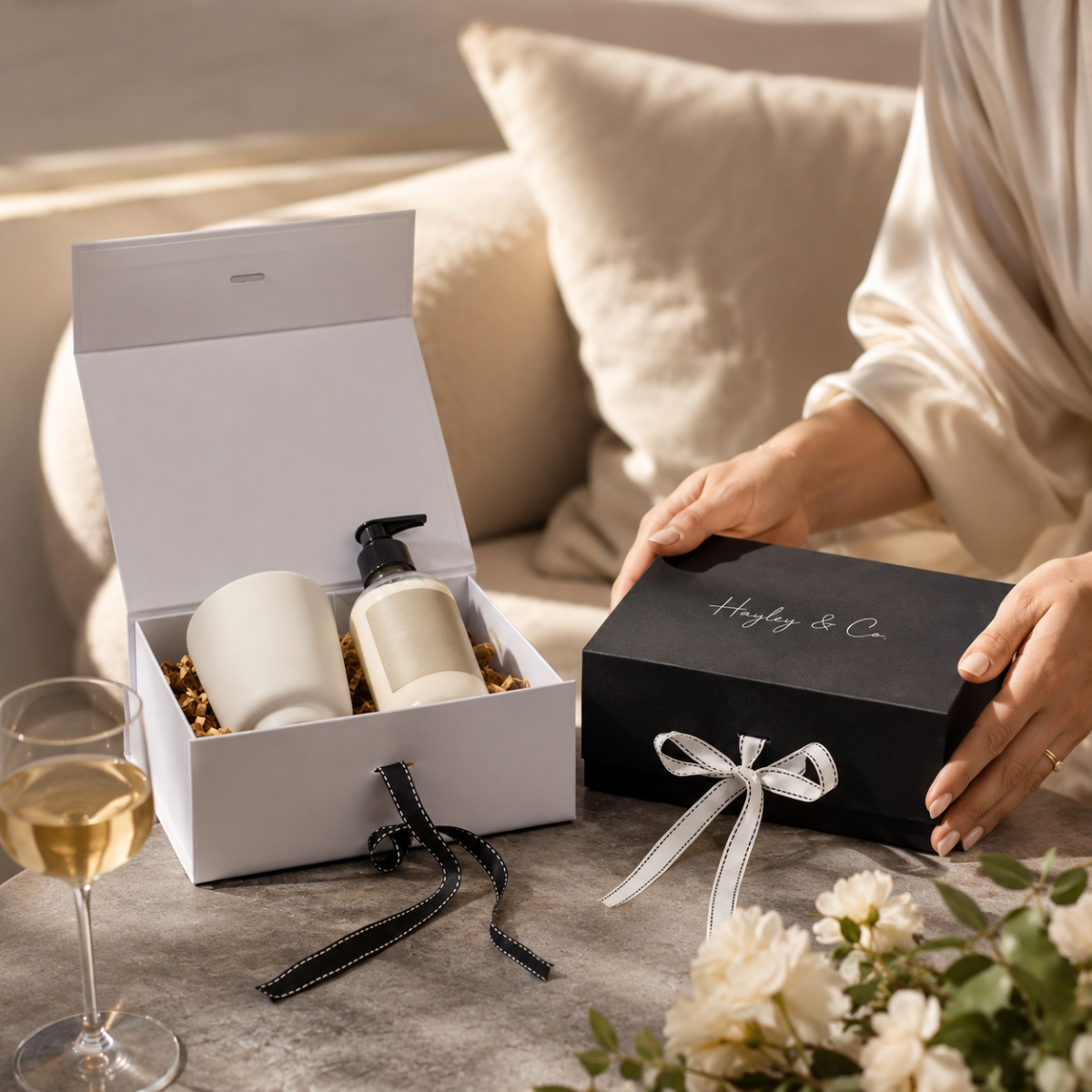
The choice between a tray-style hamper and a lidded box affects both sizing and presentation.
Tray-Style Hampers
A tray can provide:
- Open product visibility.
- Quick packing access.
- A display-led presentation.
- Easy use with clear wrapping or a sleeve.
- A lower overall structure.
However, it may require additional protection or outer packaging for delivery.
Lidded Hampers
A lidded hamper can provide:
- A concealed reveal.
- More complete product coverage.
- Better stacking potential.
- A surface for branding.
- A more traditional gift-box experience.
The lid construction may reduce internal height or require extra clearance around the products.
Choose the format by considering retail display, gifting experience, transport, storage, and packing speed, not only appearance.
Window Hampers And Product Visibility
A window can display the contents while keeping them inside a structured box.
When sizing a window hamper, consider:
- Which products need to remain visible.
- The position of labels.
- The distance between the product and window.
- Whether products can move out of view.
- How the window affects stacking.
- Whether the window remains flat.
- The material used for the window.
- How the different components may be separated after use.
The insert should hold products in the intended viewing area.
A larger window does not automatically improve presentation. It should frame the products rather than reveal empty gaps or protective materials.
Test With A Simple Card Mock-Up
Before ordering samples, make a basic internal-space mock-up.
Use card, paper, or a reusable tray to represent the proposed length, width, and height. Place the actual products inside and assess:
- Overall footprint.
- Product spacing.
- Label visibility.
- Height differences.
- Insert requirements.
- Presentation balance.
- Empty areas.
- Potential movement.
- Ease of removal.
This is not a replacement for a production sample, but it can quickly eliminate unsuitable sizes.
Photograph each arrangement from above and at the expected opening angle. The layout that looks efficient on a measurement sheet may feel very different when viewed as a gift.
How Much Empty Space Is Too Much?
Empty space is not automatically a problem. It can help create visual focus, allow finger access, and prevent products from appearing crowded.
It becomes a problem when it:
- Allows products to move.
- Requires excessive filler.
- Makes the hamper look unfinished.
- Increases the shipping size unnecessarily.
- Weakens the presentation.
- Creates inconsistent packing.
- Makes the box difficult to store economically.
Each empty area should have a reason.
Space around a hero product may feel deliberate. A large unexplained gap beside a small jar usually does not.
Avoid Packing Products Too Tightly
A very close fit may seem efficient, but it can create problems during packing and use.
Products packed too tightly may:
- Be difficult to insert.
- Rub against one another.
- Damage labels.
- Put pressure on glass.
- Distort the insert.
- Make items difficult to remove.
- Slow the packing process.
- Perform inconsistently when product dimensions vary slightly.
Include realistic manufacturing variation in the product, label, insert, and box.
A sample built around one unusually small jar may not represent the next delivery.
Test The Unboxing Experience
Size affects the recipient’s experience from the moment the lid opens.
Check whether:
- The products remain in their intended positions.
- The main item is immediately visible.
- Labels face the right direction.
- The arrangement looks full but not crowded.
- Each product can be removed comfortably.
- Protective materials feel purposeful.
- The gift can be repacked if required.
- The box still looks neat after the first item is removed.
Packaging should make the gift easier to enjoy, not turn product removal into an escape-room challenge.
Shipping And Outer Packaging
A hamper gift box may still need an outer shipping box for courier delivery.
The combined packaging needs to account for:
- Hamper external dimensions.
- Protective space around the hamper.
- Packed weight.
- Movement inside the outer box.
- Corner protection.
- Courier handling.
- Labels and documents.
- Returns requirements.
Choosing a very large hamper can increase the size of the outer shipping packaging as well as the amount of internal protection required.
Test the complete shipping configuration, not only the presentation box.
For businesses managing recurring product deliveries, read Subscription box packaging explained.
Stacking Hampers Safely
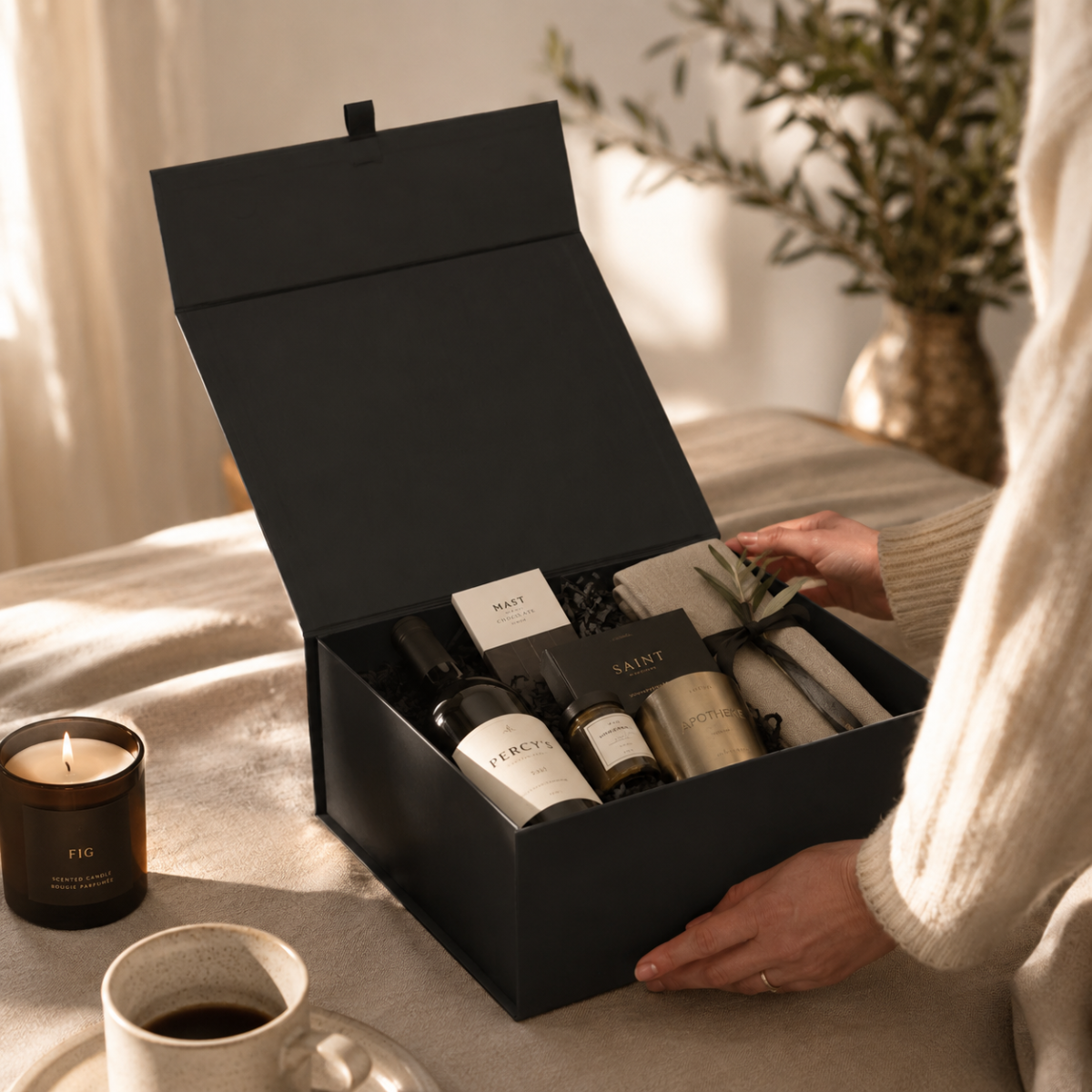
Stacking can save warehouse and packing-station space, but it also places pressure on the lower boxes.
Before stacking packed hampers, assess:
- Combined product weight.
- Box construction.
- Lid strength.
- Stack height.
- Storage duration.
- Humidity and temperature.
- Whether contents create uneven pressure.
- Whether a window can deform.
- Whether boxes slide against one another.
Do not assume that an empty hamper’s appearance predicts its packed stacking performance.
Agree suitable stacking and storage guidance with the supplier and test the actual packed format where required.
Improving Order Fulfilment With Fewer Box Sizes
A small product range does not always need a different hamper for every gift set.
Where possible, identify a controlled family of sizes that supports several arrangements.
For example:
- A compact size for one or two small products.
- A medium size for core gift sets.
- A larger size for premium or seasonal collections.
The exact dimensions should reflect the actual products rather than generic size names.
A smaller packaging range can help with:
- Stock control.
- Reordering.
- Storage.
- Staff training.
- Packing consistency.
- Supplier management.
- Photography.
- Inventory forecasting.
Avoid reducing the range so far that every product is packed into an oversized box. Standardisation should support the product rather than weaken the presentation.
Packing Instructions For Repeatable Gift Sets
Once a box size and arrangement are approved, document the setup.
Include:
- Box SKU.
- Insert SKU.
- Product list.
- Product orientation.
- Placement order.
- Required protective materials.
- Label direction.
- Finished-box photograph.
- Quality checks.
- Outer shipping packaging.
- Any weight or handling requirements.
For small teams, a clear photograph may be enough to prevent inconsistent arrangements.
For growing operations or a fulfilment company in the UK, structured packing instructions help ensure the presentation remains consistent when fulfilment moves beyond the founder’s own desk.
Managing Packaging Inventory
Hamper sizing affects how much packaging stock the business must store.
Before ordering, consider:
- Minimum order quantity.
- Flat or assembled storage format.
- Carton size.
- Reorder lead time.
- Seasonal sales.
- Product-launch timing.
- Number of packaging SKUs.
- Storage conditions.
- Forecast variation.
- Supplier reliability.
A premium box that is frequently unavailable is not a dependable packaging solution.
Test the core sizes first, keep the range understandable, and confirm restocking expectations with the supplier before building a product offer around a specific format.
Shipping Returns And Reuse
Where customers may return products, consider whether the hamper and its outer packaging can support the journey.
Ask:
- Can the products be placed back into the insert?
- Does the lid still close after opening?
- Is the outer packaging reusable?
- Are return instructions clear?
- Does the decorative presentation interfere with secure repacking?
- Can the box withstand the expected handling?
A gift hamper may not be intended as the sole returns package, but its size and construction can still affect how easy the process feels.
Cost-Effective Hamper Sizing
The lowest-priced box is not always the most cost-effective choice.
A poorly sized hamper may increase costs through:
- Excess filler.
- Larger outer shipping boxes.
- Higher storage requirements.
- Slower packing.
- Product damage.
- Rework.
- Additional packaging SKUs.
- Higher rejection rates.
- Inconsistent presentation.
- More complex stock management.
Compare the complete packed cost, including:
- Hamper box.
- Insert.
- Protective materials.
- Outer shipping packaging.
- Labour.
- Storage.
- Delivery.
- Damage or returns.
- Packaging waste.
Any cost-saving claim should be based on the business’s own verified order and fulfilment data.
Sustainable Packaging Solutions
Sustainable packaging starts with choosing an appropriate size.
A right-sized hamper may help reduce unnecessary board, filler, outer packaging, and shipping volume. These benefits should still be described accurately and supported where claims are made.
Ask suppliers about:
- Board and paper composition.
- Recycled content percentages.
- FSC-certified options.
- Plastic-free material options where available.
- Window materials.
- Laminations and coatings.
- Adhesives.
- Component separation.
- Production waste controls.
- Packaging reduction opportunities.
- Supplier documentation.
“Biodegradable packaging materials” and “eco-friendly packaging materials” are broad terms. Confirm the exact material, conditions, certification, and disposal route before using them in customer-facing claims.
Avoid unsupported terms such as “100% sustainable”, “zero-waste”, or “planet-saving”.
Common Hamper Box Sizing Mistakes
Choosing By External Dimensions
The usable internal space may be smaller than the headline box dimensions.
Measuring Products Separately
Measure the complete arrangement, including dividers and protection.
Forgetting Caps And Lids
The widest or tallest point may not be the main body of the product.
Ignoring Weight
Several compact jars can create a substantial combined load.
Adding The Insert Last
The insert reduces the available internal space and should be included from the start.
Using Filler To Correct An Oversized Box
Decorative material cannot always prevent movement or create a purposeful presentation.
Testing The Empty Box Only
The packed product may change the base, walls, lid, or stacking performance.
Ordering Too Many Sizes
A complicated packaging range increases storage and stock-management demands.
Standardising Too Aggressively
One large box for every gift set can increase waste and weaken presentation.
Approving Without A Shipping Test
A beautiful hamper may still need extra protection for courier handling.
Hamper Box Sizing Checklist
| Check | What To Confirm |
|---|---|
| Product dimensions | Every item measured at its widest and tallest points |
| Arrangement | Final product layout agreed |
| Internal box size | Length, width, and height checked |
| Insert | Walls, dividers, and supports included |
| Protection | Required cushioning included |
| Packed height | Lid closes without pressure |
| Product movement | Items remain in their intended positions |
| Weight | Box and insert suit the combined load |
| Presentation | Labels and hero products remain visible |
| Removal | Products can be lifted out comfortably |
| Shipping | Outer packaging and handling assessed |
| Storage | Box format suits available stock space |
| Repeatability | Different packers can reproduce the layout |
| Sustainability | Claims supported by material evidence |
| Supplier approval | Final sample and specification retained |
Explore Hamper Gift Boxes
The best hamper size makes packing simpler and the gift feel more considered.
Explore our range of hamper gift boxes and compare the internal dimensions against your complete product arrangement before placing a larger order.
FAQs
How Do I Choose The Right Hamper Box Size For My Products?
Measure the complete arranged footprint of the products, then add the space required for the insert and protective packaging. Compare the result with the box’s internal length, width, and height.
What Should I Consider When Selecting A Hamper Box Size?
Consider product dimensions, weight, layout, insert construction, cushioning, lid clearance, shipping method, storage, packing speed, and presentation.
How Can I Fit Bottles, Jars, And Gift Sets Into A Hamper?
Start with the largest or most important item, then arrange the remaining products around it. Use suitable dividers or inserts to prevent movement and test the packed box before ordering stock.
What Are The Dimensions Of Common Hamper Box Sizes?
Hamper dimensions vary between products and suppliers, and labels such as small, medium, or large are not standard measurements. Compare the listed internal dimensions with your own product footprint.
How Does Product Size Affect Packaging Choice?
Product dimensions determine the minimum internal footprint and height. Shape, weight, fragility, and label orientation also affect the box and insert required.
What Are The Benefits Of Using The Right-Sized Hamper?
A suitable size can improve product stability, presentation, packing consistency, stock management, and shipping efficiency while reducing unnecessary filler and empty space.
How Can Hamper Packaging Be Cost-Effective And Sustainable?
Use a box that fits the complete arrangement without excess space, standardise a sensible range of sizes, and request clear evidence for materials, recycled content, and certifications.
Which Products Fit Well In Particular Hamper Sizes?
Compact hampers may suit one or two small jars or accessories, while larger boxes may suit bottle combinations or multi-product gift sets. Exact suitability depends on the internal dimensions and complete packed arrangement.
How Can Packaging Improve Product Presentation?
A considered layout keeps products facing the right direction, gives the main item visual focus, and prevents products from shifting before the box is opened.
How Can Packaging Improve Order Fulfilment And Inventory Management?
A controlled set of hamper sizes, clear packaging SKUs, photographed layouts, and documented packing instructions can simplify stock control and help different packers produce consistent results.